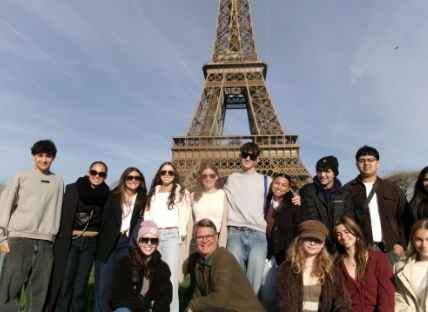
The Capitoline Museum in Rome was filled with tourists slowly taking in its galleries. Around them, four high school students and a Latin teacher wove urgently through rooms with a single goal: find the Lupa.
The bronze she-wolf statue–the iconic figure who, according to legend, nursed Romulus and Remus–is more than a symbol of Rome’s founding. For these scholars, it represented the foundation of their Latin education.
This spring break marked the return of the Latin trip, which hadn’t seen the light of day since 2015. From March 17-23, the group of nine, including seven students and two teachers, used Rome as a home base to explore. For Upper School Latin teacher Ms. Anderson, who led the excursion, this trip marked a return to routine; it was her 12th time bringing a group of students to Italy.
“It was bittersweet,” Anderson remarked. “I think about kids that I’ve taught in the last 10 years since the last time we went that wanted to go so badly, and I did not get to take them.” Still, she reflected that she “couldn’t have picked a better group to travel with.”
Ms. Cunningham, the Middle School Latin teacher, felt lucky to be a part of this dream team. Monumentally, after 23 years of teaching Latin in the classroom, this trip was her first to Italy.
When recalling the Lupa mission, she shared how the cohort made the “special moment for a Latin scholar” even more extraordinary: “We understood each other’s excitement, and our conversations were on a different level because of our shared background. I knew our group understood how much the trip meant to me. In short, I was with my people.”
(Ms. Anderson)
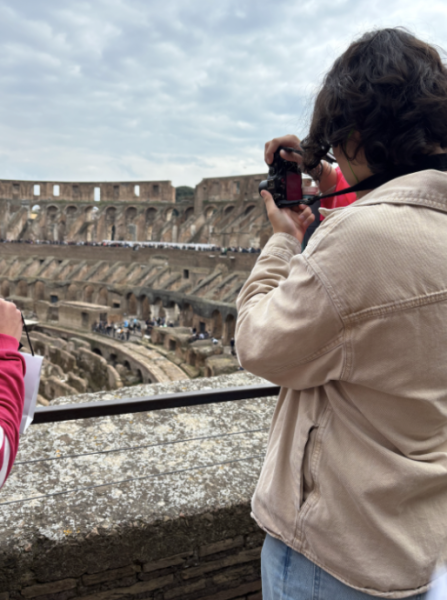
Junior Juliana Crisalli, a former student of Ms. Cunningham, had previously visited Italy. Still, she jumped at the opportunity to take a deeper look into Rome. She got exactly what she came for when she took a look inside the Colosseum for the first time, marveling at the “layers and layers of history.”
Freshman Sebastian Valdes, however, had never been to Italy. Despite being the only freshman, he decided to seize the day. Valdes reflected that being the lone freshman, while initially unexpected, was beneficial: “While I would have loved to have some of my closer friends, I’m glad I made friends…with people outside of my grade. So it actually also helped me in knowing more people.”
As a first-timer, Valdes had his assumptions. “When I imagined Rome, I thought of it purely as the sightseeing places…but looking at Rome from the inside, it is a very urban city,” he shared. Valdes found himself comparing it to the sprawl of New York City, but the convergence of modernity and antiquity felt uniquely Roman.
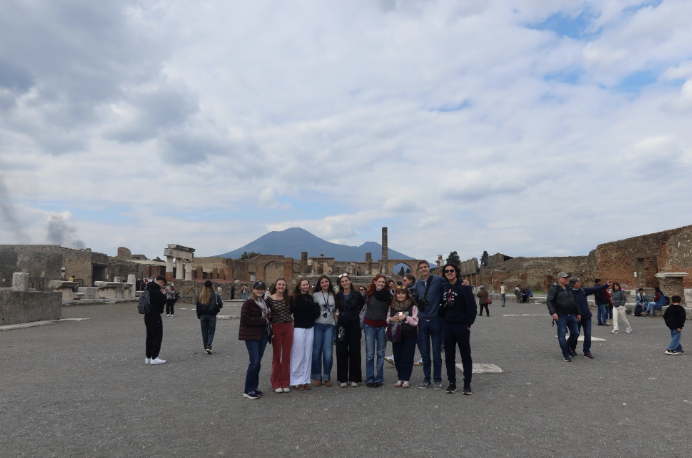
Cunningham was struck by this dichotomy. She “gained a new appreciation for the Italian people and the lengths they have gone to to preserve their past in the midst of the modern world,” figuring out the balance of “keeping that heritage safe while allowing access to it.” Cunningham found it hard to wrap her head around the contrast of taking a high-speed train in the morning and spending the afternoon walking through the ruins of Pompeii.
There, in the shadow of Mt. Vesuvius, Crisalli was brought back to the classroom. Earlier that year, her Latin IV class translated Pliny the Younger’s letters about the eruption of Mt. Vesuvius. She was struck by the collision of reading and reality: “Now we’re actually seeing it.”
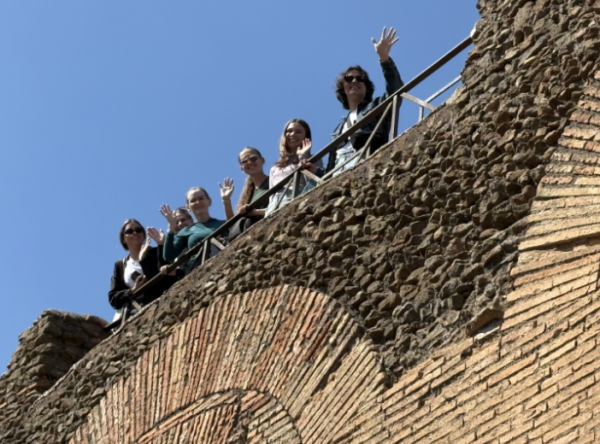
Pompeii is an indisputably iconic sight in Italy. Still, Valdes was charmed by the relative peace of Ostia Antica, another day-trip destination for the group. Tucked away on the western coast of central Italy, an hour’s bus ride from Rome, the ancient city is out of the way of most tourists’ itineraries. Valdes was grateful that their trip didn’t overlook the gem, saying, “Of course the Roman Forum is beautiful and it’s ancient––or Pompeii––but there are just so many people there, so it was really hard to get that feel for the architecture and the history.”
He found Ostia to be the place where history could come most alive. Away from the bustle of most tourists, the 2,000-year-old stones could speak above a whisper. Valdes explained, “[Ostia Antica] was beautiful because you just really got a sense for how the Romans lived.”
(Ms. Anderson)
On March 23, the group waved goodbye to The Eternal City and returned home. Back in class, Crisalli had a new outlook on Latin. “Now I understand and know that these things really did happen…it’s not just the story that someone just made up,” she said.
Anderson was thrilled to guide her scholars through moments when their studies came alive. Back in the Capitoline Museum, the group found the Lupa statue. Anderson was excited to be a part of this special moment: “That’s the actual one, it’s right here, you can touch it!” Of course, museum rules prohibited touching, but the excitement was palpable.
Later, Anderson shared her aspiration for a next step for travel: a trip that would extend to Greece, connecting Italian culture and learning to a greater context.
For Cunningham, the visit reinvigorated her “why” behind teaching. In a moment when the group was separated by the dense crowd of tourists, she found herself stopped in front of a famous piece of Greek pottery displayed in the Vatican. As the crowd flowed past her, she reflected, “At that moment, I thought that if those tourists knew the importance of the art they were walking past, they would stop too. My conviction is stronger than ever that studying classical Greece and Rome informs our modern lives in invaluable ways.”
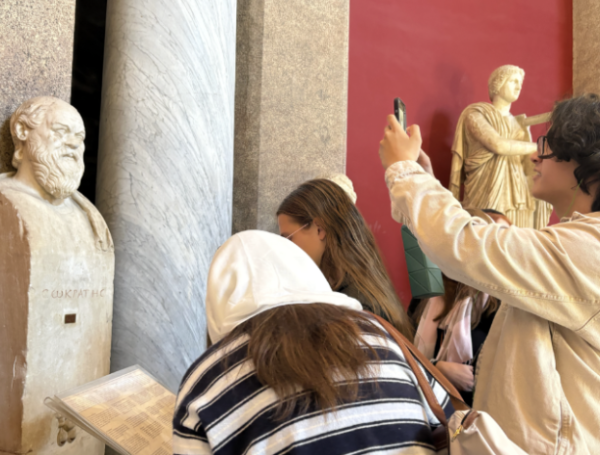
(Ms. Anderson)
Before pursuing Latin, many students presume that it’s a “dead” language. Latin may no longer be spoken in everyday conversation, but this trip proved to these scholars that Latin is still breathing. It lives in the stones of Pompeii, the worn wagon tracks in Ostia, and in the bronze gaze of the Lupa.
Not everyone will notice the famous pottery amidst the noise and bombardment of the world. Not everyone will look twice at the “dead” ruins, but Cunningham knows the value of those who do: “I am reinvigorated in my quest to share that world
with my students, so they will be the kind of people who stop and look.”