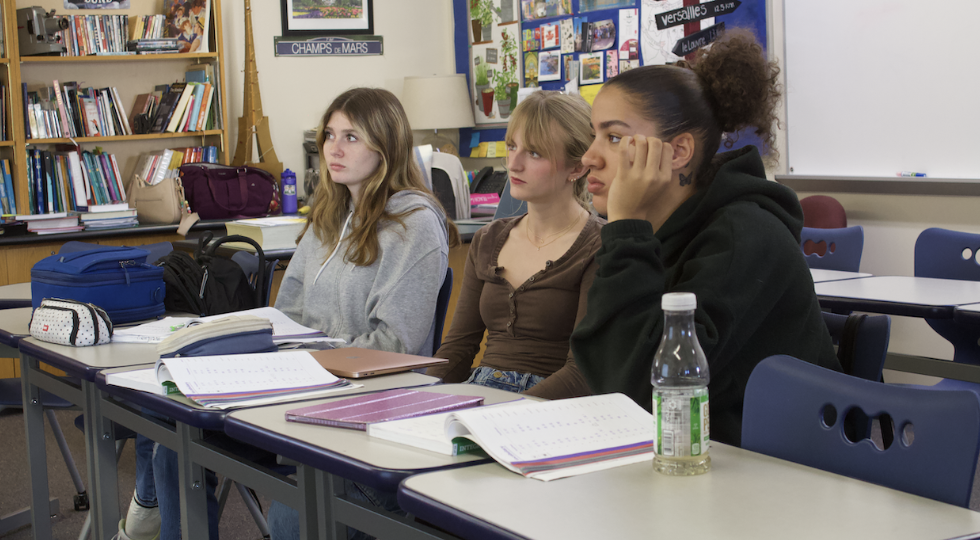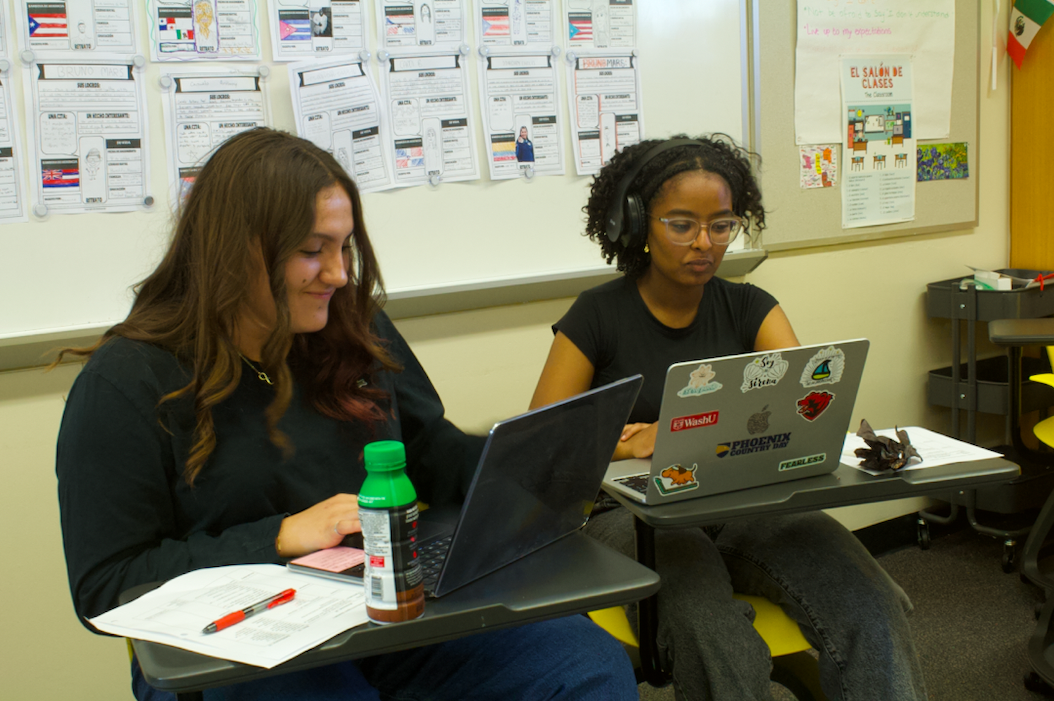
Each day, dozens of PCDS students sit in brightly colored chairs in classrooms on the west side of the Upper School Quad. They are there to learn Spanish. But in the back of their minds, they raise a glaring question: why?
In the age of artificial intelligence, the PCDS Spanish program faces uncertainty. Nonetheless, its soul is alive. While the Mandarin program will sunset after the 2025-2026 school year in part due to its lack of connections to the community, the Spanish program is deep-rooted, serving as a microcosm of Arizona.
Fewer than 1% of households in Arizona speak Chinese, according to Statistical Atlas. Meanwhile, Arizona is the sixth-largest Spanish-speaking state in the U.S., based on percentage of population. There are approximately 1.3 million Spanish speakers in the state, nearly 17% of the population, as evidenced by World Population Review.
Several PCDS students fall into this category, as they have grown up in bilingual households.
Sophomores Alec Saenz and Emilio Saenz are originally from Guadalajara, Mexico, and they spent two years of their childhood in Spain. Growing up, their parents only spoke to them and their siblings in Spanish.
“It’s kind of annoying to be nagged to speak Spanish at home, but in retrospect, it was good. It’s a huge advantage for us, and I use my Spanish all the time with people in Phoenix.” Emilio Saenz said.
Emilio Saenz works at Camp Catanese Foundation in Central Phoenix, a nonprofit organization that prepares underserved students for college and careers. He has helped families apply to high schools such as PCDS and has given tours to Spanish-speaking families at the annual PCDS open house. “Being able to translate and help families that reminded me of my own was cool,” he said.
Alec Saenz teaches swimming at Aqua-Tots. His bilingualism allows him to establish trust with Spanish-speaking parents. “I tell [parents], ‘your kid is going to be safe with us.’ And it helps a lot to have a common language.”
Bilingualism not only opens doors for communication, as in the Saenz brothers’ case, but also yields cognitive benefits.
Studies from McGill University and Georgetown University, among others, reveal that compared to monolingual people, bilingual people have heightened “efficiency of communication between brain regions,” less shrinkage of grey matter (which is essential tissue for cognition that starts decreasing at an early age), and advantages in certain aspects of memory. Bilingual preschoolers have even shown more empathy than their monolingual counterparts.
The act of learning a new language, not just being bilingual from childhood, also strengthens neural pathways. In their colorful chairs, as they engage with a foreign language, PCDS students exercise Broca’s area, the part of the brain responsible for articulating ideas and accurately using words; Wernicke’s area, helping them comprehend written and spoken information; and the angular gyrus, which allows them to connect words with other ideas and images, according to the Fein Memory and Aging Center at the University of California San Francisco.
Despite the plethora of benefits that learning and speaking a second language offer, Upper School Spanish teachers see dwindling motivation amongst their students.
Ms. Camelia Tumminello is in her 6th year of teaching Spanish at PCDS. This school year, she has noticed some of her students question the significance of the learning process. “Sometimes I do feel like the motivation to do more may be lacking a little bit,” she said. “That grit that really makes you want to learn for the sake of learning.”
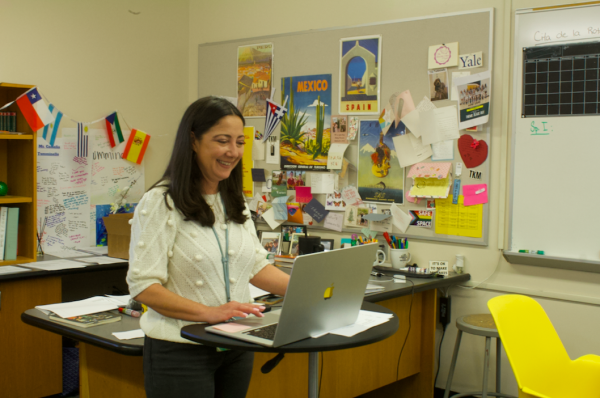
While she attributed this in part to a natural second-semester decline in motivation, she also raised concern about the role of A.I. in the classroom.
“It’s a little bit scary,” Ms. Tumminello worried.
Ms. Meily Riehle, who is in her 11th year of teaching Spanish at PCDS, agreed. “I don’t understand [A.I.] completely,” she admitted. “It’s very hard to teach using it as a learning tool and not a substitute, skipping the learning process in the mix.”
Mr. Aaron Arizmendi is in his third year teaching Spanish at PCDS. “[A.I.] is a navaja de doble filo,” a double-edged sword, he quipped. It helps temporarily. But when a student has a limited understanding of the material as a result of their A.I. use, it’s harmful.
To combat A.I.’s creep, Spanish teachers have gone back to the basics: handwritten assignments and on-the-spot practice as opposed to digital homework. Concurrently, they are learning to embrace LLMs, albeit carefully. Ms. Tumminello said that she has encouraged her students to study with A.I.-generated practice questions based on their notes, and Ms. Riehle “[tries] to use it so that [she] can get a better understanding of how to better apply it for assignments.”
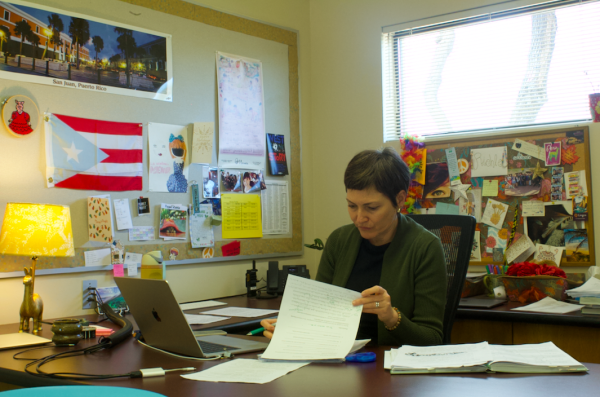
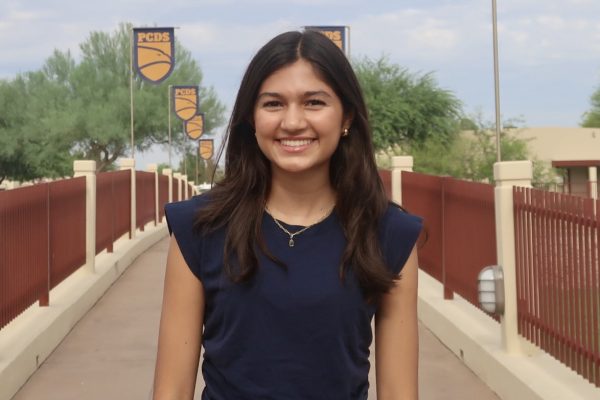
While A.I. poses a threat to students’ interest in language acquisition, senior and leader of the PCDS Spanish Club Petra Danek still sees the value.
As a baby, Danek spent time with her Spanish-speaking neighbor while her parents were at work. At two years old, she began to attend a Spanish immersion school, where she learned how to read and write in Spanish before English.
“When I came to PCDS, I still kept doing my Spanish tutoring on the side…I knew I didn’t want to lose it. And I felt like it’s just really important to me,” she said.
Danek is deeply committed to the Spanish language and embracing the culture of Spanish-speaking countries. Beyond taking simple actions to develop her skills, such as switching her Instagram algorithm to Spanish, she also pursued an independent study, where she completed the last two levels of fluency (there are six levels). Furthermore, Danek has organized a salsa dancing class, a scavenger hunt, and holiday celebrations for the PCDS Spanish club.
“Even here in the U.S., so many people speak Spanish, and it’s so needed, especially in Arizona. I think that it’s really cool to be able to communicate with people in their first language,” Danek said. “I’ve always felt that even though A.I. is going to take over, there’s this sense of humanity that comes with knowing multiple languages.”